2025 Annual Report
A Message from the Executive Director
For over fifty years, the Ethics Law has guided government officials and employees across Ohio in their decision-making while exercising their public authority and spending taxpayer funds.
The Ohio Ethics Commission provides timely legal advice and guidance that also prevents violations of the law. When appropriate, we conduct thorough and objective investigations to hold accountable those who fail to comply. We create and present engaging, in person and online training to educate public servants on their responsibilities and obligations under the law. We also administer a robust financial disclosure program for those required to file statements.
This annual report for calendar year 2025 summarizes Commission activities in the past year and highlights the work of the bipartisan Commission and its staff at all levels of state government. The Commission works closely with state and local agencies and legal departments to promote awareness of and compliance with the Ethics Law.
All Ohioans benefit when public decisions and expenditures are objective and made with the public’s best interest in mind and not the private interests of their public servants.
Sincerely,
Paul M. Nick
About Us
The Ohio Ethics Law became effective on January 1, 1974. These laws established a code of ethics for public officials and employees, created financial disclosure requirements for certain public officials, and prohibit public officials and employees from:
- acting on conflicts of interest;
- selling goods or services to their own public entities;
- abusing public positions for private business opportunities.
The Ohio Ethics Commission is authorized to issue advisory opinions, conduct investigations, provide training on the law, receive and administer the financial disclosure requirement, and make legislative recommendations to the General Assembly.
The Ethics Commission is an independent, bipartisan commission, comprised of six members serving staggered, six-year terms. Commissioners are appointed by the Governor and subject to confirmation by the Ohio Senate.
Review current and past members of the Ohio Ethics Commission on our Commission Members page.
Advisory
The Ethics Commission has statutory authority to provide guidance to both the public and private sectors. This authority enables the Commission to apply uniform statewide standards to protect the public and assist the requesters in avoiding conflicts of interest. Countless violations are prevented through the Commission’s timely guidance and advice.
The Ethics Law contains a valuable incentive to encourage people to seek advice. Anyone who requests an opinion prior to engaging in the conduct may rely upon the opinion and, if the opinion is permissive, that person is immune from criminal prosecutions, civil suits, or actions for removal from office or employment. No one needs to guess if their conduct might violate the law – all they have to do is ask.
2025 Highlights
-
Advisory Opinion No. 2025-01
- Updated the definition of “family member” to include domestic partners
- Reinforced full recusal requirements (including hiring decisions and matters involving the employment of family members)
-
Advisory Opinion No. 2025-02
- Modernized the prior restrictions on the use of frequent flyer and other rewards points to match the federal government standard
- Required that the accrual of any such rewards must not cost the public agency any additional money and must be under the same conditions available to the public
-
Cryptocurrency
- In partnership with the Commission’s financial disclosure section, staff issued the first guidance on how to report cryptocurrency and other digital assets on disclosure statements
- Added five new frequently asked question responses to the Commission’s website
By the Numbers
-
Issued 194 written opinions
- Median response time was 9 days (96% were answered in 45 days or fewer)
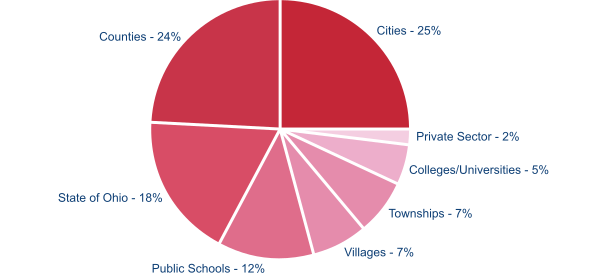
- 65% of these advisory requests come from local governments, including counties, cities, townships, villages, and public schools
-
Responded to 1,368 phone calls and emails
- 91% answered within 1 day
- 63% were from local government entities
2025 Written Opinions Issued by Entity Type
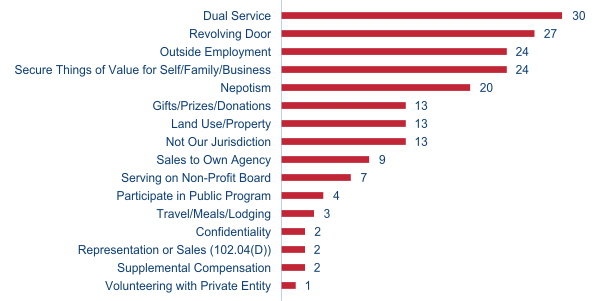
2025 Written Opinions By Topic
Investigations
The Ohio Ethics Commission is charged with investigating allegations and complaints of violations of the Ethics Law. The outcome of an investigation may include a referral for criminal prosecution, closure, or resolution by a public Settlement Agreement or a confidential Notice of Potential Violation.
The Commission’s investigations are confidential by statute. Its investigative team often partners with other law enforcement and investigative agencies to avoid duplication of resources and coordinate multijurisdictional investigations.
2025 Highlights
-
Issued 53 Notices of Potential Violation
- Average closure time was 60 days
- Allowed for quicker resolution of less severe issues
- Issued 12 Settlement Agreements
- Received 1 formal, sworn complaint alleging a conflict of interest violation by a former County Recorder. (This complaint was dismissed for failing to meet statutory requirements and was referred to another law enforcement agency for review)
- 16 investigations were referred to or pending with prosecutors, including one case that resulted in a conviction by a jury
By the Numbers
- 151 cases investigated
- 1,091 investigative contacts
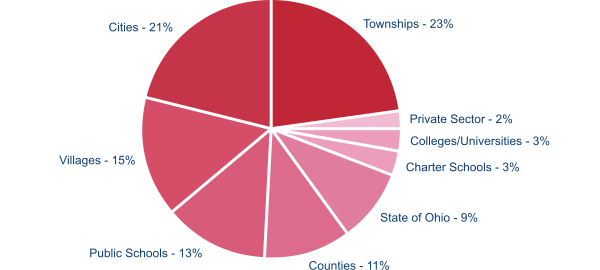
- 91% of respondents served in local government positions, including counties, cities, townships, villages and public schools
- Closed 85 cases, including settlements and notices of potential violations
- Conducted investigations in 38 counties
2025 Investigations by Entity Type
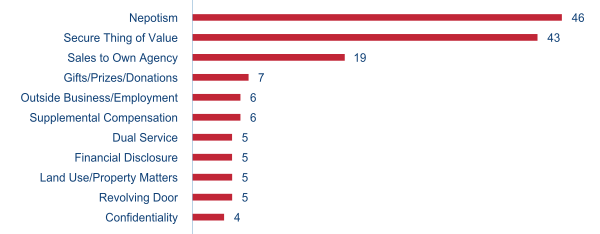
2025 Investigations by Topic
Training
The Commission’s Education and Training program provides information about the Ethics Law in readily available and easy-to-understand formats. Our toolkit includes in-person speeches, live webinars, recorded on-demand classes, Continuing Legal Education classes, fact sheets, quarterly newsletters, and even an ethics true-crime podcast.
2025 Highlights
-
Launched The Voice of Ethics Podcast (September 2025)
- Ethics “true crime” stories and guidance under Ohio law
- Issued four newsletters with updates and announcements to nearly 1,500 subscribers
By the Numbers
- 149 public appearances to 13,426 people
- 31 webinars with 2,700+ electronic attendees
- 72,000+ learners trained by the 2025 e-course
- 91,652 visitors to our website
What People Are Saying
Webinars
“You kept the group engaged with a well-planned slide deck, incredible sense of humor and high energy delivery. Your training was a great way to kick off our year!”
In-Person Sessions
“I have attended several of your OUTSTANDING sessions and just wanted to thank you for all you do to educate those of us who need it. Thank you for making ethics exciting."
E-Course
“Giving real-life examples instead of lifeless hypotheticals made understanding the material much easier, and that's so important for this course.”
Podcast
“I listened to the first episode, and I was blown away. It was outstanding. Perfect length. Great light-hearted tone. Good examples. Absolutely amazing. Great job.”
Financial Disclosure
In 2025, the Ohio Ethics Commission processed and received 10,018 financial disclosure statements from 1,300 agencies across the state. These statements report on potential conflicts of interest from the prior calendar year involving personal financial and fiduciary interests and help filers identify their own potential conflicts of interest.
Most of these statements are a public record, except for about 2,500 statements filed mostly by uncompensated members of boards and commissions. The Commission reviews these statements for potential conflicts of interest and makes those portions of these statements publicly available.
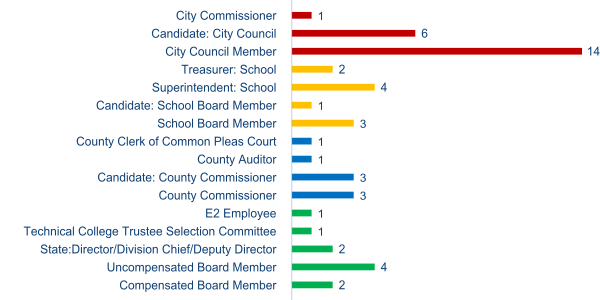
2025 Formal Complaints Against Non-Filers by Position
When a person fails to file a required financial disclosure statement, the Commission first attempts to obtain compliance by sending a series of reminder and warning letters. If the person still fails to comply, then Commission staff file a formal complaint. Under the law, failing to file a disclosure statement that is required by law is a fourth-degree misdemeanor.
In 2025, the Commission initiated 48 Formal Complaints for failing to file Financial Disclosure Statements.
The non-filer’s positions vary from candidates to elected officials along with appointed State Officials or Employees.
The Commission conducted a total of 15 formal complaint hearings and referred 15 matters for prosecution in 2025. Currently, there are 62 total criminal cases pending in Franklin County Municipal Court.